
A pet owner whose dog has just torn a cruciate ligament does not browse. They search, scan the first three results, and call. A referring general practitioner choosing where to send that same case does something similar, except they are searching your surgeon’s name and your procedure pages. Both journeys end in a search box, and both are winnable.
That is why SEO for veterinary surgeons matters more than it did five years ago. Surgical practices sit in an unusual position: you compete for emergency intent, elective intent, and professional referral intent at once, and most veterinary marketing advice only addresses the first. This guide covers all three.
Why SEO for Veterinary Surgeons Is Not the Same as General Practice SEO
Most articles about vets SEO assume you are a neighbourhood clinic chasing “vet near me.” Generic guidance on seo for veterinary practices stops there. That keyword matters if you do vaccinations and wellness exams. It matters far less if you run a referral-only orthopaedic or soft tissue service.
Three differences change the entire strategy:
Your catchment area is wider. Pet owners will drive ninety minutes for a board-certified surgeon, but not for a nail trim. Local SEO for vets built around a three-mile radius will undersell you.
Half your buyers are other vets. Referring practices research surgeons the way patients research specialists: credentials, case examples, referral forms, and a phone number that reaches someone. Almost no competitor content addresses this, which makes it a genuine opening.
Your money terms are procedure names, not “veterinarian.” “TPLO surgery cost,” “brachycephalic airway surgery,” and “feline perineal urethrostomy” convert at a rate broad veterinary search engine optimization terms never will.
Anyone selling you seo services for veterinarians that ignores those three points is selling you a general practice template with your logo on it. The same applies to any vet seo agency that treats seo for veterinary surgeries as interchangeable with wellness clinic marketing.
The demand behind all of this is measurable. AVMA reporting on specialty and primary care (March 2025) cites a Trupanion analysis of 5.7 million claims from December 2019 to November 2024 showing neurology claims up 47 percent and cardiology claims up 55 percent for dogs across that period. The same reporting covers a CareCredit survey in which 54 percent of pet owners said they had little or no knowledge of specialty care, 80 percent named cost as their top concern, and only 25 percent of specialty practices provide cost information before the appointment.
Read those three numbers together and you have the whole search opportunity in one line: owners are looking for explanations and prices that almost nobody publishes.
Start With Intent, Then Build Your Keyword Map
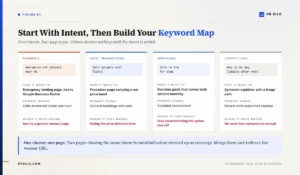
Good veterinarian keywords sort themselves into three buckets, and each bucket needs a different page type.
Emergency intent. “Dog swallowed sock surgery,” “cat blocked bladder.” These happen at 2am on a phone and need a fast page, a tap-to-call button above the fold, and clear hours.
Research intent. “Is TPLO worth it for an older dog,” “recovery time after splenectomy.” These happen before the decision and deserve long, genuinely useful articles.
Commercial intent. “Veterinary orthopaedic surgeon [city],” “TPLO cost [city].” These need a procedure page with pricing guidance, surgeon bios, and a booking path.
Practical veterinarian search engine optimization means mapping every page you own to exactly one of those buckets. When a single page tries to serve all three, it usually ranks for none of them. This is the single most common structural failure in seo for veterinary practices, and it is also the cheapest one to fix.
Pull your veterinarian keywords from four places: Google Search Console queries you already receive, the “People also ask” boxes on your target terms, the intake questions your front desk hears every week, and the procedure list on your own services page. That combination beats any keyword tool used in isolation, and it is the part of seo for veterinary surgeons most practices rush.
Local SEO Still Does the Heaviest Lifting
Even for referral practices, the map pack is where a large share of local clicks land. Local SEO for veterinary clinics comes down to four unglamorous jobs done consistently.
Google Business Profile, treated as a live asset
Claim it, verify it, then maintain it. Primary category is the single highest-weighted local pack factor in Whitespark’s 2026 Local Search Ranking Factors report, scoring above even proximity to the searcher, so choose the most specific primary category available, add every procedure as a service with its own description, upload real photographs of your facility and team, and answer the Q&A section yourself before someone answers it wrong. Practices doing local SEO for veterinarians well post at least twice a month, because an active profile is the cheapest win in local seo for vets. Most competitors have not posted since setup.
Citation consistency
Your clinic name, address, and phone number must match character for character across Google, Bing Places, Apple Business Connect, Yelp, and the veterinary directories your clients use. Inconsistent listings quietly suppress rankings, and they are trivially fixable. It is dull veterinary search engine optimization, but skipping it caps everything above it. Local SEO for veterinary hospitals with multiple entrances or suite numbers should pick one canonical format and enforce it everywhere.
Location pages that are not clones
If you operate from three sites, each needs its own page with its own parking instructions, its own team, its own embedded map, and its own reviews. Duplicating one page three times with the city name swapped is the oldest mistake in vet seo marketing and Google has been ignoring it for a decade. Proper local seo for veterinary clinics and disciplined vet seo marketing treat each site as its own business.
Reviews, gathered as a habit
Reputation management for veterinarians is a ranking factor and a conversion factor at once, which is why it belongs inside your local seo for veterinarians plan rather than beside it. Build review requests into discharge: a text sent two hours after a successful surgery outperforms anything said at the front desk. Respond to every review, including difficult ones, in plain language and without breaching confidentiality. Online reputation management for vets is not about suppressing criticism. Done well, reputation management for veterinarians is a differentiator rather than damage control, and online reputation management for vets belongs on the marketing calendar, not in a crisis folder.
The numbers support treating this as a weekly habit rather than an annual push. BrightLocal’s Local Consumer Review Survey 2026 found 97 percent of consumers read reviews for local businesses, 31 percent will only use a business rated 4.5 stars or higher, and 74 percent want to see reviews written within the last three months. Your replies count too: 80 percent say they are likely to use a business that responds to all of its reviews, while 50 percent are actively put off by responses that read as templated. Whitespark’s 2026 report also flags review signals as one of the two factor groups gaining weight this year.
Build a Dedicated Page for Every Procedure
This is the highest-return move available to surgical practices, and it is the one most often skipped.
Each significant procedure needs its own URL covering the condition, how you diagnose it, what the surgery involves, realistic recovery timelines, expected cost range, and what a referring vet needs to send you. Add a short case summary with before and after imaging where you have consent, plus the surgeon’s name and credentials.
This is not a hunch. In Whitespark’s 2026 report, “dedicated page for each service” is the highest-weighted factor of all for local organic results, ahead of geographic keyword relevance and inbound link authority. A clinic with eighteen procedure pages out-ranks a clinic with one “Our Services” page every time, because eighteen pages each target a specific query while one targets a vague one. If you want the procedure page structure and on-page fundamentals handled properly, that is the work to brief first. Seo for veterinary surgeries is largely a question of how granular you are willing to get, and granularity is where seo for veterinary surgeons separates from general clinic marketing.
Veterinary Website Optimization: The Technical Floor
None of the above works on a slow, fragile site. Veterinary website optimization is mostly about clearing a technical floor, not chasing perfection.
Get mobile right first, because most pet owner searches happen on a phone, often on a weak connection. Compress every image, keep largest contentful paint under two and a half seconds (Google’s published threshold for a “good” LCP, measured at the 75th percentile of real page loads), and make the phone number a tappable link in the header of every page.
Then add structured data. This is where most veterinary website seo work stops short, and it is a fast way to pull ahead. At minimum, implement VeterinaryCare schema on your homepage and location pages, FAQPage schema on your FAQ blocks, MedicalProcedure or Service markup on procedure pages, and Review markup where you display testimonials. Google’s LocalBusiness structured data guidance asks for the most specific subtype available, which for a clinic is VeterinaryCare rather than a generic business type. Schema is how search engines and AI systems understand what you do without guessing, and it is a direct input into whether you get pulled into rich results.
Keep the architecture shallow. Any procedure page should be reachable in two clicks from the homepage. Modern veterinary websites design often prioritises visual polish over crawl logic, and the result is beautiful sites where half the content sits four levels deep. Ask whoever handles your veterinary websites design to map navigation against your procedure list before a page is built.
Finally, fix the basics that quietly bleed traffic: broken internal links, missing alt text, pages returning soft 404s, and an XML sitemap that has not been resubmitted since the last redesign. A quarterly technical audit catches all of it, and it is the cheapest veterinary website seo you will ever buy.
Content That Answers the Question Before the Phone Rings
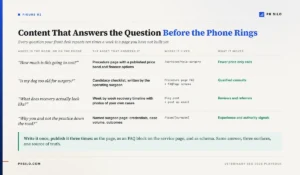
Search engines reward practices that publish genuinely useful material, and so do pet owners. The trick is writing for the moment before the appointment, not after it.
Strong formats for seo veterinary campaigns include post-operative care guides for worried owners, honest cost breakdowns, “when is this an emergency” decision guides, and anaesthesia safety explainers for senior animals. Each is a question your team answers on the phone ten times a week, and each is a seo veterinary asset that earns for years.
Build SEO optimized pet care FAQs into the relevant pages rather than isolating them in a single FAQ page. A question about crate rest belongs on the TPLO page, not three clicks away. This helps users, and it gives AI systems clean question-and-answer pairs to lift. Well-built SEO optimized pet care FAQs are among the most cited content on a clinic site.
One caution: veterinary content sits squarely in Google’s your-money-or-your-life category. Every clinical article needs a named author with credentials, a review date, and citations to veterinary literature where claims are made. Veterinarians SEO without demonstrable expertise on the page is a losing position in 2026, and the gap between practices that treat veterinarians SEO as a clinical exercise and those that outsource it blindly is widening.
Authority, Links, and Digital PR
Directory listings are table stakes. Real authority comes from earning coverage, and this is where most veterinary seo marketing programmes stop too early. Links are the part of veterinary seo marketing that cannot be automated.
Realistic link sources for a surgical practice include veterinary school and residency pages, local news coverage of unusual cases with owner consent, breed club and rescue partnerships, guest contributions to veterinary trade publications, and commentary for journalists writing about pet health. One placement in a respected veterinary publication beats fifty directory submissions.
Digital PR works here because veterinary stories are compelling to general media. A complex reconstruction, a rescue collaboration, or original data from your own caseload can all earn coverage no outreach spam will match.
The weighting data agrees. Whitespark’s 2026 report places “quality and authority of inbound links to domain” third among all local organic factors and “quantity of inbound links from industry-relevant domains” fifth, while noting that citations have continued their multi-year decline. Translated: one link from a veterinary publication now outweighs a batch of directory entries by a wide margin, and the gap is widening each year.
Getting Cited in AI Overviews and Chat Assistants
This is the gap almost nobody in the veterinary space is covering yet, and it is where the next three years of advantage sits.
Pet owners increasingly ask ChatGPT, Perplexity, Gemini, and Google’s AI Overviews before they ever see a traditional results page. The scale of the shift is documented: a SparkToro study of Similarweb clickstream data, reported by Search Engine Land in June 2026, found 68.01 percent of US Google searches ended without a click in the first four months of 2026, up from 60.45 percent in 2024. AI Overviews now appear on more than 20 percent of searches, and when one appears, click-through rates fall by close to 60 percent. Those systems do not rank pages so much as select passages to cite. Optimising for that is a different discipline, sometimes called generative engine optimisation, and it is quickly becoming a core part of seo for veterinary surgeons. A few things consistently help:
Write in direct answer format. Lead each section with a two-sentence answer, then expand. AI systems extract clean, self-contained statements far more readily than meandering paragraphs.
Use precise, attributable claims. “Recovery from TPLO typically takes eight to twelve weeks with restricted activity” is citable. “Recovery takes a while” is not.
Keep entity information consistent everywhere. Practice name, surgeon names, credentials, and location should read identically across your site, your Google profile, veterinary directories, and any press coverage. AI systems build confidence through corroboration.
Get mentioned on sources these systems already trust. Veterinary associations, universities, and established publications are over-represented in AI citations, which makes digital PR and AI visibility the same project.
Monitor it. Run your key queries through the major assistants monthly and log whether you appear. Most competitors measure none of this.
Two Scenarios the Standard Advice Ignores
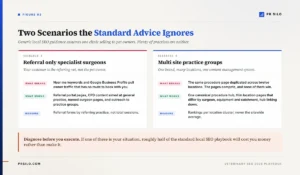
SEO for veterinary ER and after-hours services
Emergency search behaviour is unlike anything else here. Volume spikes overnight, at weekends, and around holidays. Queries are symptom-led, and decisions take under two minutes. The AVMA reporting cited earlier notes that 63 percent of owners seeking advanced care skipped the referral entirely and went straight to an emergency practice, which means these searches are often the first and only touchpoint you get.
Build symptom-specific pages (“dog ate chocolate,” “cat straining to urinate”) that open with triage guidance and end with your address and phone number. Make your Google Business Profile hours reflect genuine after-hours and holiday availability, because an incorrect “closed” label costs you the call. SEO for animal hospitals with an emergency arm should treat these pages as a separate content pillar. Done properly, seo for veterinary er work fills overnight capacity that would otherwise sit idle, and the same logic applies to seo for animal hospitals running weekend urgent care. Multi-site groups should fold this into local seo for veterinary hospitals planning rather than bolting it on later.
How to optimize cat rescue website for SEO
Rescues face the same search landscape with none of the budget. Priorities shift: adoptable animal pages with unique descriptions and fresh photos, location plus breed pages (“adopt a kitten in [city]”), donation pages optimised for branded search, and a Google Business Profile despite having no storefront. If you are researching how to optimize cat rescue website for seo, start with the adoption listings, because they carry both the demand and the conversion.
How to Choose a Veterinary SEO Company
Most practices eventually hire help. The market is crowded and the quality range is enormous, so a few filters save a lot of money.
Ask for named clients in veterinary medicine. Any credible veterinarian seo agency can show you practices you can call. A veterinarian seo agency or vet seo agency without one nameable clinic has not done this work. The same test applies to any seo services for veterinarians pitch that leans on generic “healthcare” experience. Vague references to “healthcare clients” are a warning sign.
Ask what they will report on. A good vet seo company reports appointments booked and calls tracked, not keyword positions in isolation. If the proposal from a veterinary seo company leads with ranking screenshots and never mentions revenue, keep looking. Good veterinarian seo services are sold on pipeline, not on graphs.
Ask who writes the clinical content. Veterinary content written by someone with no veterinary background reads exactly like what it is, and it will not earn citations. The better veterinarian seo company arrangements include veterinary review of everything published, and the strongest veterinarian seo company teams retain a vet directly.
Ask about ownership. You should own your website, Google profile, content, and analytics. Some agencies structure agreements so that leaving means starting over.
Understand what you are buying. A full-service veterinarian seo & marketing group bundles SEO, paid search, and website work. A specialist vet seo company does one thing deeply, and for many practices a focused veterinarian seo & marketing group beats a generalist. A vet seo service on a fixed monthly retainer suits a single practice; a growing group needs something custom. Ask any vet seo service provider how they scale across locations before you sign.
Be sceptical of guarantees. Nobody can guarantee a position, and the seo company for vets that promises one is usually the seo company for vets to walk away from. What good veterinarian seo experts can promise is a documented process, transparent reporting, and a realistic timeline. The veterinarian seo experts worth hiring tell you what they cannot do as readily as what they can.
On timeline: most practices see early movement in local rankings within eight to twelve weeks and meaningful organic growth between six and nine months. Any veterinary seo agency promising page one in thirty days is either misleading you or planning tactics that will cost you later, so treat that promise as a filter for every veterinary seo agency you speak to.
Pricing for veterinary seo services runs from a few hundred dollars a month for basic local work to several thousand for competitive multi-location programmes. Quality veterinary seo services and credible veterinarian seo services are priced against the value of a new surgical client, not against an hourly rate, and cheap retainers usually buy automated reporting and little else.
Measure the Things That Actually Matter
Rankings are a leading indicator. Appointments are the result. Measure veterinary practice seo with call tracking on key landing pages, form submissions tagged by source, Google Business Profile calls and direction requests, and, where your PIMS allows, new client records matched to first-touch channel.
Set up conversion tracking before you start, not six months in. Measurement is what separates veterinary practice seo from an expense. Practices that struggle to justify spend on seo services for animal clinic website work are the ones that never instrumented anything, so decide how you will judge seo services for animal clinic website performance before the first invoice.
A monthly one-page summary is enough: calls from organic, calls from the map pack, new clients attributed to search, and cost per acquired client. That is the conversation that keeps seo experts for veterinarian services honest, and any seo experts for veterinarian services who resist it are telling you something.
Frequently Asked Questions
Q1. How Long Does SEO Take to Work for a Veterinary Practice?
Expect local ranking movement within eight to twelve weeks and substantial organic growth between six and nine months. Newer domains and competitive metro markets sit at the longer end. Emergency and symptom-led content sometimes ranks faster because fewer practices compete for it.
Q2. Is Local Seo Enough on Its Own, or Do I Need Broader SEO Too?
Local SEO handles the map pack and nearby searches, which is most of the volume for a general practice. Surgical and referral services also need procedure-level content and authority building, because owners and referring vets search by condition and credential across a much wider geography.
Q3. How Much Should a Veterinary Practice Budget for SEO?
Single-location practices typically spend between several hundred and a couple of thousand dollars monthly. Multi-site groups and emergency hospitals spend more. Judge the number against cost per new client rather than against another practice’s invoice.
Q4. Can I Do This Myself Instead of Hiring an Agency?
Yes, for the fundamentals. Claiming and maintaining your Google Business Profile, cleaning up directory listings, gathering reviews, and writing procedure pages are all achievable in-house. Technical audits, schema implementation, and link earning usually need outside help. Most practices handle the basics in-house and bring in seo for veterinarians specialists once the fundamentals are set.
Q5. Which Directories Matter Most for a Veterinary Clinic?
Google Business Profile first, then Bing Places, Apple Business Connect, Yelp, and your national veterinary association directory. Add breed-specific and specialty referral directories relevant to your caseload. Depth of accuracy beats breadth of listings.
Q6. Do Online Reviews Affect Where My Practice Ranks?
Yes. Review volume, recency, rating, and your response rate all feed local ranking signals, and they influence click-through once you appear. A steady trickle of new reviews outperforms a burst followed by silence.
Q7. What Are the Most Common SEO Mistakes Veterinary Practices Make?
Duplicating location pages, hiding services inside a single page, letting a redesign break existing URLs, publishing unattributed clinical content, ignoring the Google Business Profile after setup, and measuring rankings instead of appointments.
Q8. Does the Same Strategy Work Across Multiple Clinic Locations?
The framework transfers, the execution does not. Each location needs its own page, its own profile, its own review stream, and its own local content. Centralise the strategy and the technical standards; localise everything a pet owner would notice.
Q9. How Do I Get My Practice Cited in Ai Overviews and Chatgpt Answers?
Write clear, self-contained answers near the top of each section, use precise and verifiable claims, implement schema markup, keep your practice details consistent across the web, and earn mentions on veterinary sources these systems already trust. Then check your key queries monthly to see whether it is working.
Q10. How Should a Referral-Only Surgical Practice Attract More Referring Vets?
Build a referral section aimed at professionals: downloadable referral forms, clear case criteria, surgeon biographies with board certification detail, published case outcomes, and a direct line for clinical questions. Optimise those pages for searches like “veterinary orthopaedic surgeon referral [region]” rather than owner-facing terms. AVMA reporting found only 36 percent of referred owners were told anything about the specialist’s experience, so publishing that detail fills a gap the referral conversation is leaving open. Referral acquisition is the most underused angle in seo for veterinary surgeons.
Q11. Is SEO Better Value Than Google Ads for a Veterinary Clinic?
They do different jobs. Ads buy immediate visibility and stop the day you stop paying. SEO compounds and keeps working, but takes months to build. Most practices run paid search for emergency and high-margin procedure terms while building organic visibility underneath it.
Q12. What Should I Ask an Agency Before Signing?
Ask for named veterinary clients you can contact, a sample report, confirmation that you own all assets, who writes and reviews clinical content, the notice period, and exactly what happens in months one through three. Clear answers are the point; a polished deck is not. If you want to test that on us, talk to our team.
Where to Start This Week
If you take one thing from this guide, make it this: pick the three procedures that generate the most revenue and build a proper page for each. Then fix your Google Business Profile and set up a review request that fires automatically after discharge. Those three moves cost almost nothing and account for a disproportionate share of what good seo for veterinary surgeons actually delivers.
Everything else, the technical audit, the digital PR, the AI visibility work, builds on that foundation, and it is worth sequencing as a full SEO programme rather than a series of disconnected projects. Practices that skip the foundation and buy links first tend to spend a year discovering why that order matters. Any honest SEO veteran will tell you the boring work comes first, and every SEO veteran in vets SEO says the same about veterinarian search engine optimization.