
It’s 7 a.m., you’ve already burned two mistakes on the connections puzzle today, and the streak you’ve guarded since spring is suddenly very breakable. So you do what half the internet does and type connections hint forbes into a search bar, hoping for a nudge and nothing more.
That connections hint forbes search is a gamble, though. Click the wrong result and the full solution greets you before you asked for it, or you land on a recap of some other day’s board with today’s date pasted on top, which is somehow worse. Below, we’ll walk through what that coverage actually is, a way of reading any hints page one layer at a time, the handful of tricks the grid pulls over and over, and how we sorted the trustworthy pages from the junk.
Quick spoiler note: every example here comes from boards that already ran (November 3 and 6, 2026), so nothing touches the grid on your screen right now.
What People Mean by Connections Hint Forbes
Forbes doesn’t make the game. The New York Times does, and since the beta opened on June 12, 2023 the boards have come from puzzle editor Wyna Liu. Forbes just writes about each day’s grid, independently, the way a sports columnist covers a match they weren’t playing in.
When a reader types forbes nyt connections hint today they’re after that morning’s column specifically, not a primer on the rules, and plenty of them abbreviate it to nyt connections forbes and expect the same thing back. The columns that serve this search usually run in a rough order: a little intro, one nudge per color, then the solution parked below a spoiler warning so nobody stumbles into it.
Which makes a connections hint forbes search a request for something layered, and the best way to use a layered thing is to peel it from the top.
The Game in Sixty Seconds
If you’ve never played: sixteen words, four hidden groups of four, one correct solution per puzzle. Each group gets a color for difficulty, and the NYT Help Center calls yellow the easiest and purple the trickiest, with green and blue somewhere between. The color tells you how hard a category is, never what it is. Make four mistakes and you’re out, so the fourth one ends it. If the game says “one away,” three of your four picks are right. New boards land at midnight local time.
A Layered Way to Use Connections Hints Today
Plenty of hints for connections pages practically shove you toward the answer section, and plenty of solvers click through and wish they hadn’t. Going slower costs maybe five minutes. Our own routine is boring, but it works.
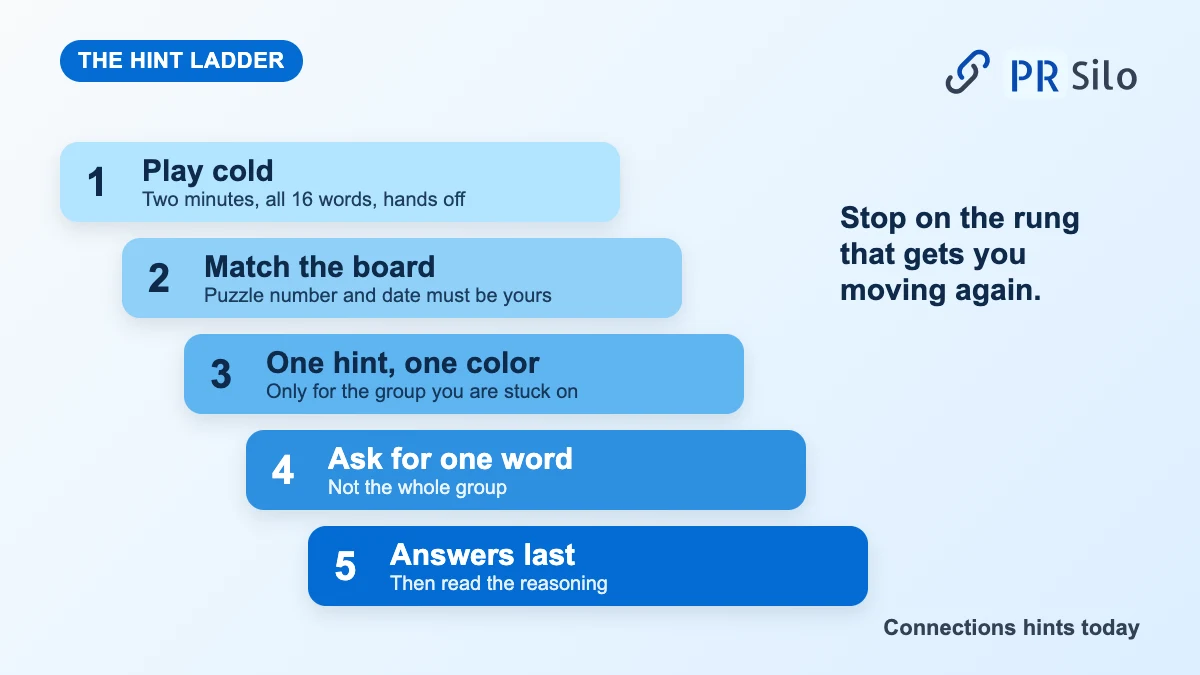
First, two minutes alone with the grid, hands off. All sixteen words, no tapping. One group usually feels safest, and before you trust that feeling, ask what else could squeeze in. Next, the page: is that puzzle number really yours, or last Thursday’s? Stale write-ups burn more guesses than bad luck ever will, and that goes for any connections hint forbes page you land on. Only after that do you pull a hint, one color, whichever group has you stuck. Still nothing? Ask for just one word from that group and see if the rest tumble out. Save the connections answers today section for the very end, and take your time with the explanation, because tomorrow’s board is where it pays off.
Searching for connections hints today is, in effect, a choice about how many rungs of that ladder to use, and you can hop off at any of them.
Four Tricks the Puzzle Keeps Reusing
Last week’s boards show these better than any theory could.
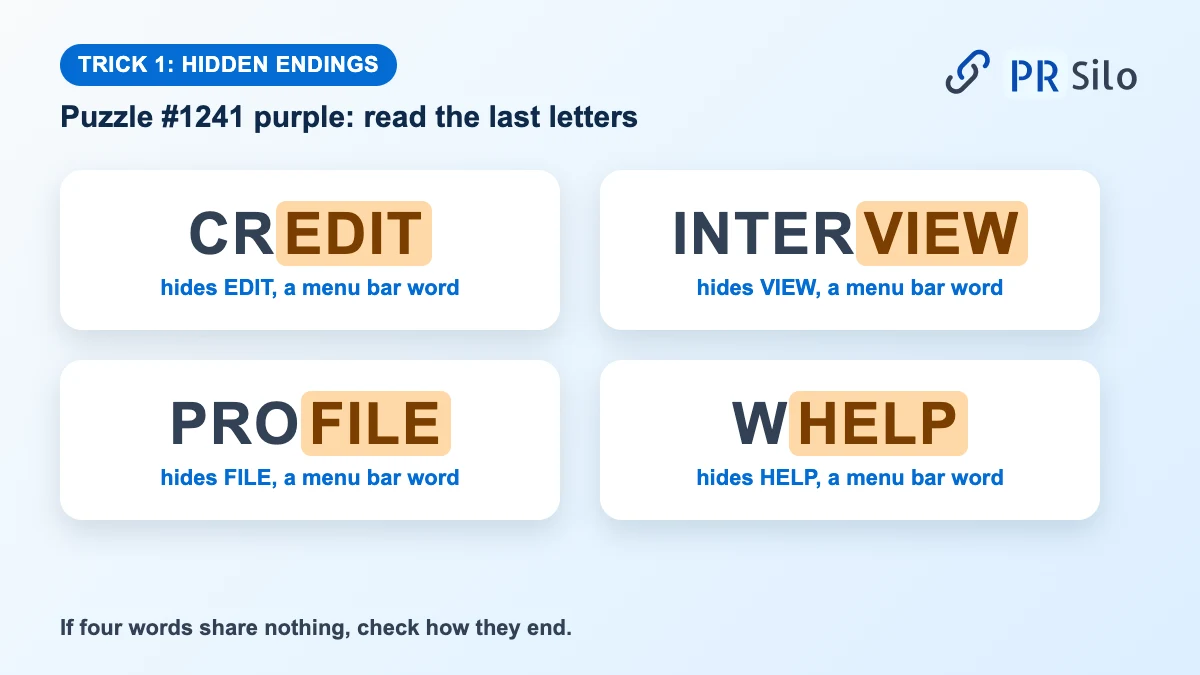
Hidden endings are the big one. Puzzle #1241, November 3: purple held CREDIT, INTERVIEW, PROFILE and WHELP, four words that have no business together until you notice they end in EDIT, VIEW, FILE and HELP (hello, menu bar). Three days on, #1244 dipped into the same well. HOT ROD, WOOLENS, TRAFFIC CONE and OSIRIS finish with ROD, LENS, CONE and IRIS, which are all parts of the eye. So when four words won’t relate, flip them around and look at how they end.
Not every trap is a hidden word, though. Some are just neighbors that look like family. The November 6 board parked a yellow group about what something’s made of (MAKEUP, FABRIC, CONSTITUTION, STRUCTURE) right beside a green group of stand-ins (BACKUP, EXTRA, REPLACEMENT, SPARE). Both are loosely “stuff,” which is exactly why people mash them together. Sort by the specific sense of each word and the broad topic stops mattering.
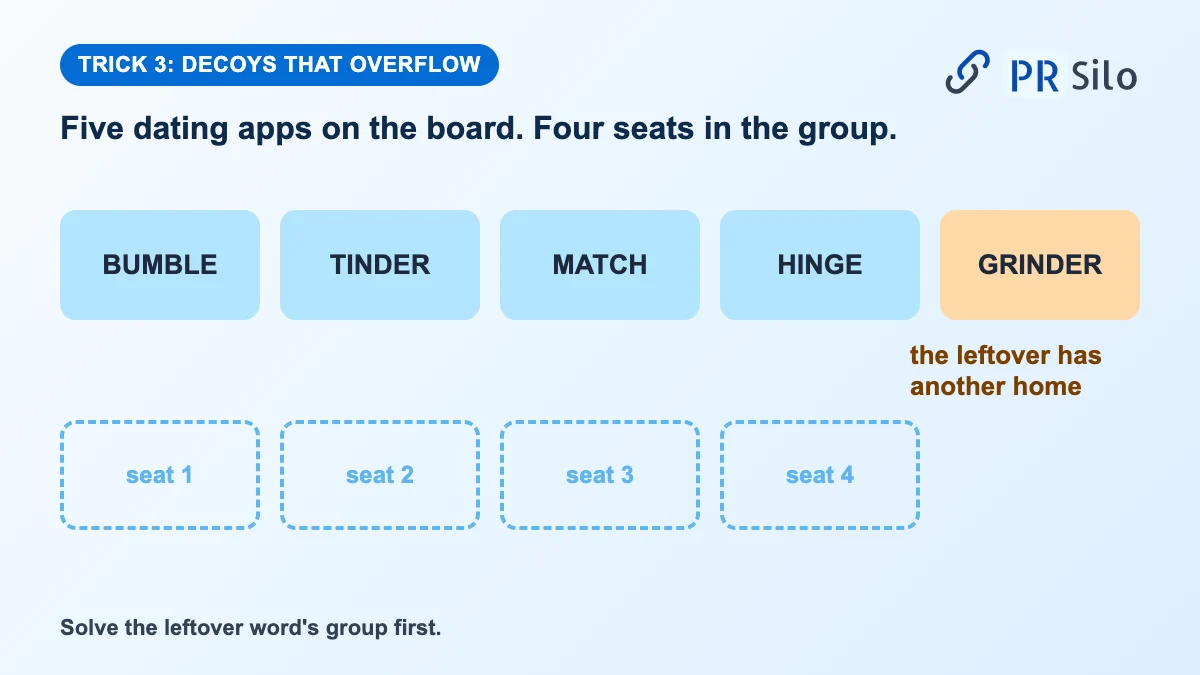
Then there’s overflow. Lifehacker flagged a Monday board with BUMBLE, TINDER, MATCH and HINGE on it. GRINDER was there too. Five apps, four seats. If you can name a fifth word that fits, you’ve found your leftover, and the leftover has a different home, so start there.
Sometimes the decoys even have a theme of their own. Red herrings are rarely random, and Lifehacker also spotted a day when the false leads all had a snake theme, which explains why your first confident guess is so often the wrong one. A decent page of connections answers today will name the decoy as well as the group, so you can see how the trap was built.
Habits That Cut Your Mistake Count
None of this takes cleverness, honestly. Saying the words out loud catches the sound-based groups. Shuffling after each solved group knocks the clumps loose. “Bank” and “spring” both lead double lives, so test second meanings, and keep an eye on names, which might be surnames, characters, brands, middle names, anything. The strangest four? Last. They tend to sort themselves out. And save hints for connections for when two full minutes of staring gets you nowhere.
Spotting a Reliable Connections Hint Forbes Page
We read six pages that rank for this topic, and the gap in quality was hard to miss. One listed fifteen words for a sixteen-word grid. Another said the game has fourteen words in one paragraph and sixteen in another. One had no hints for any board at all, and a few leaned on unnamed “other publications” as their sources, which isn’t sourcing.
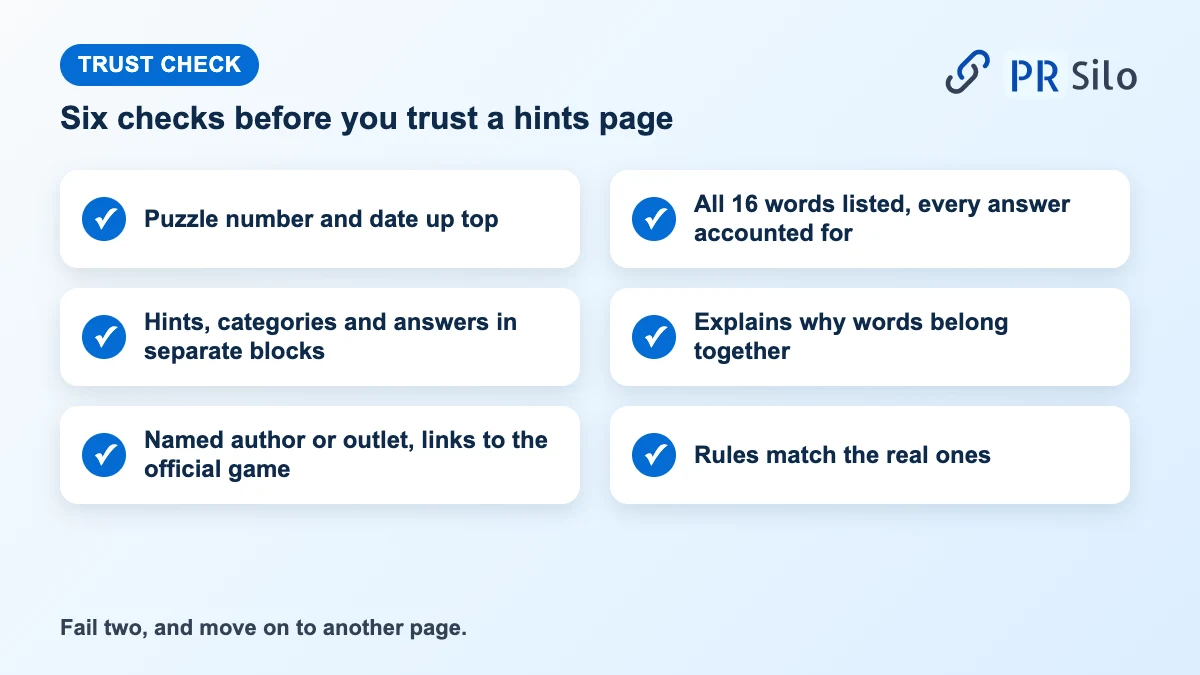
Before you lean on today’s connections hints from any site, including whatever page is chasing the forbes nyt connections hint today search, hold it up against the connections puzzle today and ask a few things. Is the puzzle number sitting right in the title or first lines? Are all sixteen words there, and do the answer groups use every one of them? Do hints, category names and answers sit in separate blocks, with a warning before the spoilers? And does anyone bother explaining why the words belong together, or is it just a list? Is a named person or outlet behind it, with a link to the official game? And do the rules match the real ones, meaning four groups of four, one solution, yellow easiest, purple trickiest?
A page that flunks two of those will probably cost you a mistake instead of saving you one.
What These Searches Teach About Search Intent
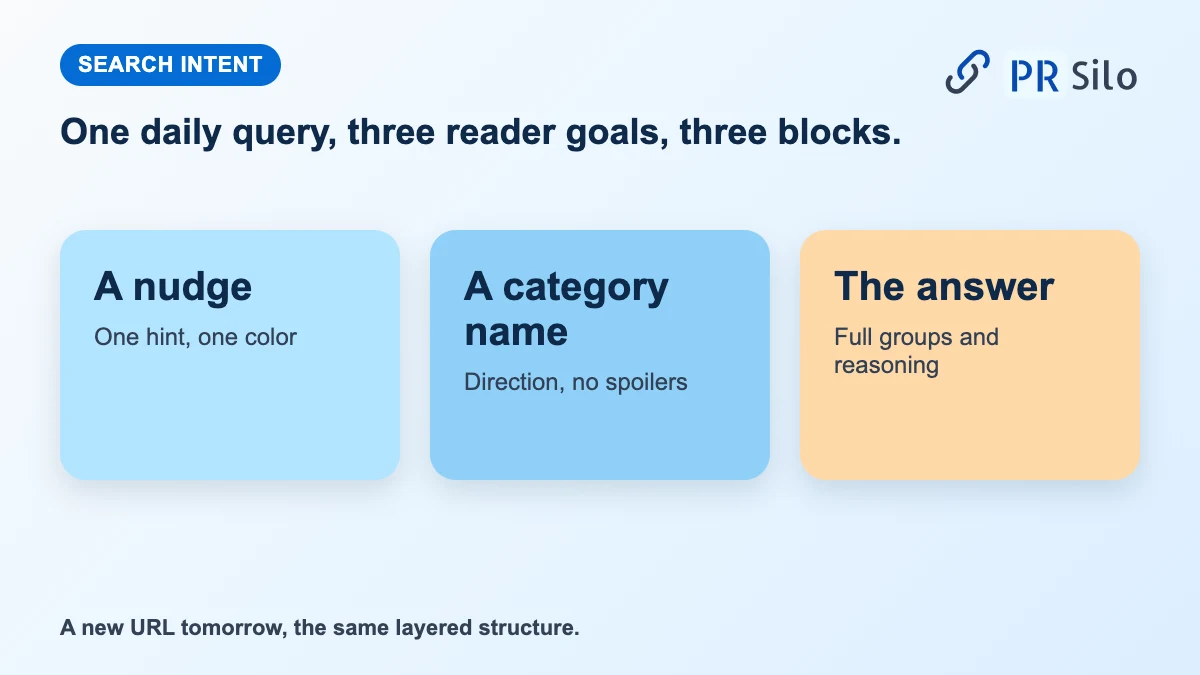
Think of a daily connections hint forbes query as a reset button, and a good case study in intent for anyone who publishes content. The right page is a different URL tomorrow, and the reader’s goal fractures three ways: a nudge, a category name, the answer itself. Give each its own labeled block and one visitor can stop at the hint while the next scrolls on, which is also why people typing nyt connections forbes land on something that suits their mood.
Searchers typing new york times connections today probably want the official board before anything else, so a page that links straight to it does them a favor. Carry that into evergreen content: quick answer high up, the detail in clear sections beneath it, every section easy to find and quote. Our content writing team builds pages around exactly this idea, aiming at Google rankings and at citations from AI answer engines, while the on-page SEO side handles headings, internal links and snippet-ready formatting. Planning a whole library of pages this way? A complete SEO solution is how the pieces get tied together.
FAQs
What does Connections hint Forbes mean?
Mostly it’s a shortcut people type when they want Forbes’ daily write-up of the NYT Connections board. Those columns tend to put hints up top and answers further down, which lets you decide how much to read.
Does Forbes make the Connections puzzle?
No, and it’s an easy mix-up. The New York Times builds and publishes the game; Forbes writes its own commentary around each board, so think of it as a companion, not the official source.
How do I find today’s Connections hints?
Add the puzzle number or the date to your search, then glance at the page to confirm that number matches your game. Older articles love to loiter near the top of the results.
How many mistakes can I make in Connections?
You get four. The fourth slip ends the round, so anything under four still counts as a win.
Which Connections color is the hardest?
Purple, by the NYT’s own description, with yellow at the friendly end. The colors are difficulty ratings rather than a solving order though, so purple won’t always be the group you save for last.
What does “one away” mean in Connections?
It means three of your four words are right and one is an impostor. The game won’t name the culprit, so reread each pick for a second meaning or a better home elsewhere on the grid.
Can I play old Connections puzzles?
If you hold an eligible NYT Games or All Access subscription, the archive is open to you. Replaying old boards is a decent way to soak up the recurring patterns.
Is the daily Connections puzzle free?
The daily board is free on the NYT Games site and app, and that’s also where you’d go for new york times connections today. A subscription is what unlocks extras such as the archive and the Connections Bot, which reviews your difficulty and mistakes.