
Somewhere around the third vendor invoice, most owners notice the same thing. The SEO freelancer wrote page titles that contradict the ad copy. The designer has never seen the email templates. The social contractor is cheerfully promoting a sale that ended on Friday. Nobody is slacking. Nobody is in charge of the whole picture, either.
Closing that gap is the whole point of a full service marketing agency. In plain terms, it is one company that plans, builds, runs and measures your marketing across several channels, so strategy, creative and reporting come from one team instead of five.
If you have typed “what is a full service marketing agency” into a search box lately, you are probably somewhere between “my marketing is a mess” and “I need someone to fix it.” This guide is built for that moment. It covers what you actually get, the different shapes these agencies come in, what they cost in 2026, how they compare with hiring in-house, and a checklist for choosing one without regretting it by month four. Short on time? Read the pricing section and the questions to ask before signing. Those two will save you the most money.
What Is a Full Service Marketing Agency?
A full service marketing agency is a single company that handles the strategy, creative work, execution and measurement behind your marketing. Rather than hiring separate specialists for SEO, paid ads, design, email and your website, you hire one team that works from one plan and gives you one person to call.
That covers the standard full service marketing agency definition. Two details matter more than the dictionary version.
“Full service” describes who owns the work, not how long the services list is. An agency that lists twelve services and quietly subcontracts nine of them to people you will never meet is a reseller with a nice website. A genuine full service marketing agency can tell you, without hesitating, who owns strategy, who approves creative and who answers for the numbers.
Strategy also has to be in the bundle. Without it you are buying a basket of tasks: some posts, some ads, a blog. A basket of tasks can still be useful, but it is not what the phrase promises.
What is a full service digital marketing agency?
It is the same model limited to online channels. A full service digital marketing agency typically covers SEO, paid search, paid social, organic social, email, content, web design and analytics. It usually skips television, print, radio and events. If your customers find you and buy from you online, this is the version you are most likely shopping for.
Where the idea came from
The model is older than the internet by about a century. N. W. Ayer & Son opened in Philadelphia in 1869 and is widely described as the first full-service advertising agency. The Smithsonian’s archive of the firm’s records notes that Ayer was the first agency to use a full-time copywriter and to set up its own art department. That was the moment agencies stopped being space brokers and started doing the creative work themselves. The firm dissolved in 2002, but the bargain it offered, one partner responsible for the message and the media, is the same one you are weighing today.
What the Work Actually Involves
So what does a full service marketing agency do all day? It depends on the agency, but full service marketing agency services tend to fall into eight areas. Not every client needs all of them from day one, and a good agency will tell you which two or three to start with.
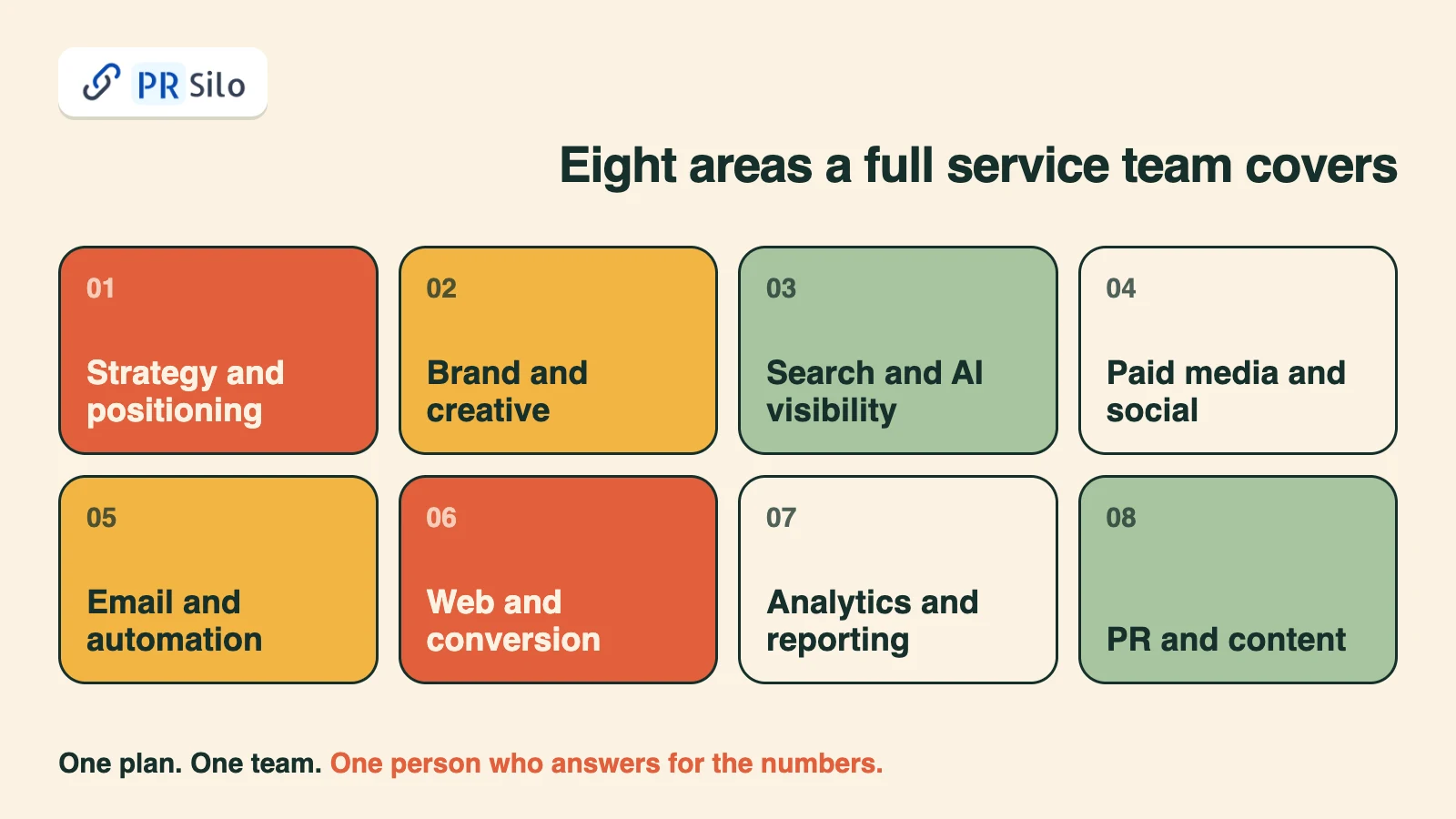
Strategy and positioning
This is the thinking that happens before anything gets published. Expect research into your customers and competitors, a clear statement of what makes you different, a channel plan with a budget attached, and a way of measuring success that ties back to revenue. The deliverables are often unglamorous: a positioning document, a messaging guide, a measurement plan. If an agency jumps to ad mockups in the first meeting, slow down and ask what the mockups are based on.
Brand and creative
Brand identity, ad creative, landing pages, video, email design and sales collateral all live here. The agencies worth paying build systems rather than one-off pieces. That means templates, resizes for every platform, and a rule for how a single campaign idea becomes thirty usable assets. Ask what happens after the hero asset is approved. If the answer is “we deliver it,” you will be paying again for every cutdown.
Search, including AI search
Classic SEO covers technical fixes, on-page work, content and link building. Increasingly, agencies also promise visibility inside AI answers, which is where more searchers are getting their information. Ahrefs analyzed 300,000 keywords in a 2025 study and found that when an AI Overview appeared, the click-through rate for the top-ranking page fell by roughly 34.5 percent. Rankings can hold steady while traffic slips, which is why measurement has to go beyond position reports.
Google’s own advice for these features is refreshingly dull: publish unique, useful content, keep the page technically healthy and make sure structured data matches what is visible on the page. There is no special AI-only markup. If an agency claims a secret formula, ask them to show a result. For the specialist version of this work, PR Silo’s complete SEO solution and technical SEO services cover both the ranking side and the crawl and speed side.
Paid media and social
Paid search, paid social, retargeting, organic social and, for some brands, creator partnerships. The key question is not “do you run ads?” but “how do the ad results feed back into the content and the website?” Agencies that treat paid and organic as separate departments tend to repeat each other’s mistakes.
Email and automation
Welcome sequences, abandoned-cart flows, lead nurturing, list cleaning and CRM setup. This is the least glamorous channel and frequently the most profitable, because the audience already knows you. A full service email marketing agency goes deeper on lifecycle flows and segmentation than a generalist team will, which is why it earns its own row in the types table below.
Web design and conversion
Building or rebuilding the site, producing landing pages, testing headlines and forms, fixing speed problems. This part decides whether all the traffic you just paid for turns into enquiries.
Analytics and reporting
Setting up GA4 and tag management, building a dashboard you can read, and connecting leads to revenue. Reporting only at month-end is a weak habit. The better teams look at the numbers weekly and change the creative while the campaign is still running.
PR and content
Digital PR, guest posts, thought leadership and the writing behind them. This is how a brand earns mentions on sites other than its own. If you want to see how the outreach side works in practice, PR Silo explains it on its digital PR services and content writing pages.
Not Every Full-Service Agency Looks the Same
The label gets stretched over very different businesses. Before you compare proposals, work out which type you are actually talking to.
| Type | What it usually covers | Best suited to |
|---|---|---|
| Full service digital marketing agency | SEO, paid search and social, email, web, content, analytics | Companies that win customers online |
| Full service integrated marketing agency | Digital plus offline channels such as events, print, radio and TV, all built around one campaign idea | Brands that need the same message at every touchpoint |
| Full service marketing and advertising agency | Brand campaigns, media planning and buying, creative production | Larger budgets and awareness goals |
| Full service B2B marketing agency | Account-based marketing, LinkedIn, sales enablement, long-cycle nurture | Firms with sales cycles measured in months |
| Full service content marketing agency | Editorial strategy, SEO content, video, thought leadership | Businesses that win through expertise |
| Full service email marketing agency | Lifecycle flows, segmentation, CRM and deliverability | Subscription, retail and membership models |
| Full service Amazon marketing agency | Listings, A+ content, Amazon Ads, retail media | Sellers who live on marketplaces |
| Full-service influencer marketing agency | Creator sourcing, contracts, usage rights, paid amplification | Consumer brands with a visual product |
A few of these deserve a closer look.
A full service integrated marketing agency is built around a single big idea that shows up everywhere, from a billboard to a welcome email. That consistency is the selling point, and it costs more to produce. A full service marketing and advertising agency leans harder on brand campaigns and media buying, which makes it a better match for awareness goals than for a business that needs leads next month.
A full service B2B marketing agency has to be comfortable with a sales team, because the handoff between marketing and sales is where most B2B pipelines leak. A consumer-facing shop that has never sat in a pipeline review will struggle there, whatever its portfolio looks like. A full service content marketing agency suits companies that win on expertise, since the work is mostly editorial.
Sellers on marketplaces have their own specialists. A full service Amazon marketing agency knows listing copy, A+ content and the ad auction inside Amazon, which a general agency usually does not. And a full-service influencer marketing agency handles the unglamorous parts of creator work: finding the right people, negotiating usage rights and paying for reach once a post performs.
You will also run into the phrases full service online marketing agency and full-service internet marketing agency. Those are older labels for the digital model, and in practice they describe the same thing as the first row. If a site calls itself a full service online marketing agency but its services page shows only web design, treat the claim with caution. The same goes for any full-service internet marketing agency that promises everything and names no team. Whatever the label on the door, whether it says full-service marketing agency, marketing agency full service or something more creative, the checks later in this guide are the same.
How an Agency Stacks Up Against Your Other Options
The useful question is rarely “is an agency good?” It is “what is the least painful way for us to get consistent marketing done?” Here is how the main routes compare.
| Option | Where it shines | Where it hurts | Fits when |
|---|---|---|---|
| In-house team | Deep brand knowledge, instant access | Hiring cost, skill gaps, turnover | You have steady work for four or five specialists |
| Full service agency | Breadth, one plan, faster start | Less day-to-day closeness, retainer commitment | You need several channels and nobody to coordinate them |
| Specialist agency (SEO, PPC, social) | Depth in one channel | You become the coordinator | Your gaps are narrow and well defined |
| Freelancers | Flexible, often cheaper per task | Quality varies, you manage everyone | You have a strong internal lead who can direct them |
| In-house lead plus agency | Control with extra capacity | Needs clear role boundaries | A marketing manager is already overloaded |
The last row deserves attention. Sagefrog’s early 2026 survey of B2B companies found that the most common answer to “agency or in-house?” was neither. It was both. And the motive for outsourcing has shifted: GTM8020’s roundup reports that only 34 percent of businesses named cost as the main driver in 2024, down from 70 percent in 2020, while 42 percent said access to specialized talent mattered most. Most buyers are not hiring an agency to save a few dollars so much as to get skills they cannot hire quickly.
The in-house maths people skip
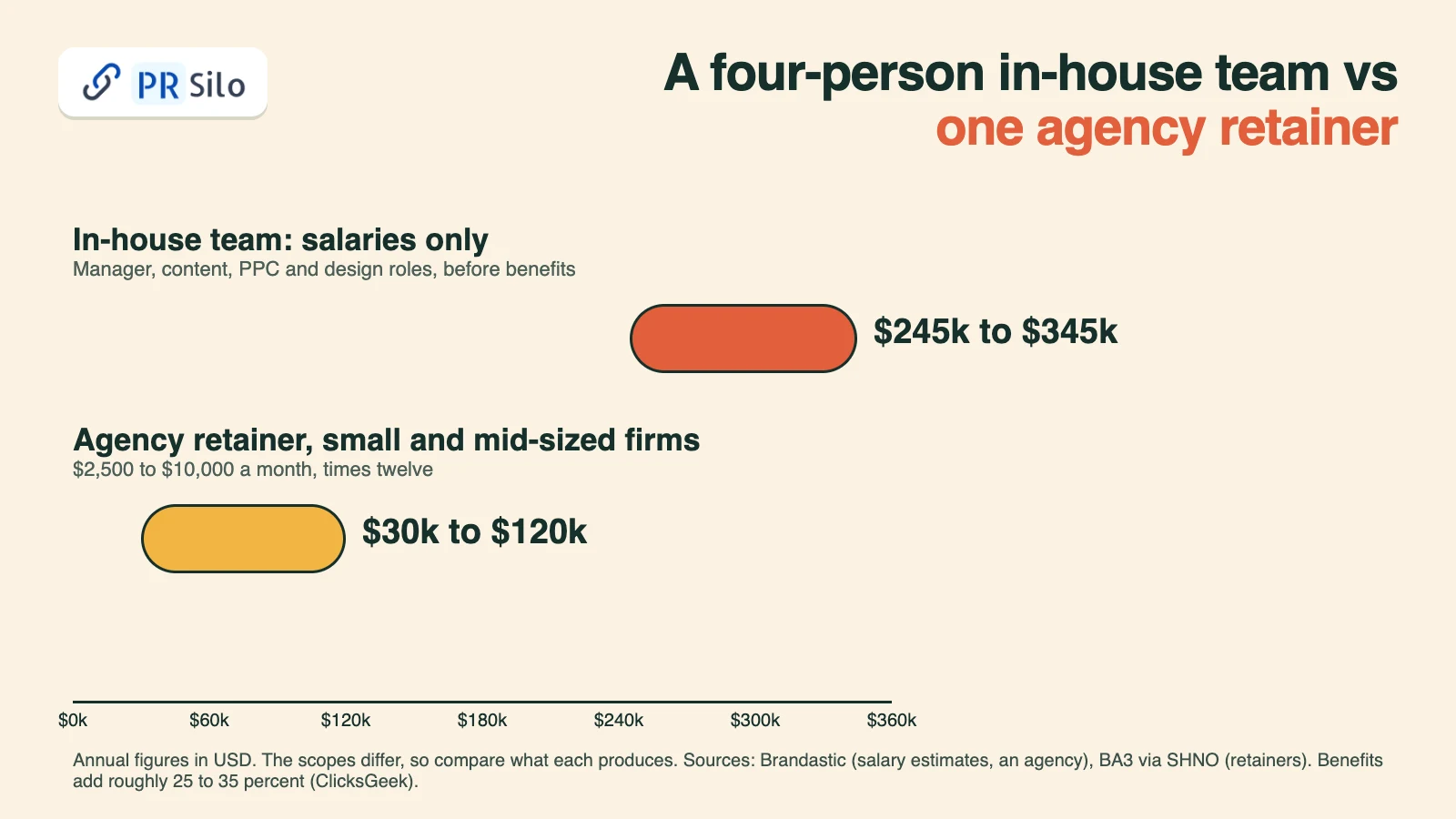
Owners often compare an agency retainer to one salary and conclude that in-house wins. That is not a fair fight. One agency estimate puts a minimal in-house team at a marketing manager ($80,000 to $120,000), a content specialist ($50,000 to $70,000), a PPC specialist ($60,000 to $80,000) and a designer ($55,000 to $75,000). Add those up and you reach roughly $245,000 to $345,000 in salaries before any benefits. ClicksGeek’s analysis suggests benefits alone typically add another 25 to 35 percent on top of base pay, and that is before software, training and the cost of replacing someone who leaves.
Treat those figures with some care, because they come from an agency that sells the alternative. The direction is still right. The real comparison is the fully loaded cost of a team against the retainer, measured by what each can produce.
Pricing: What to Expect in 2026
Pricing is the part most agencies make awkward, and plenty of them hide it behind a “contact us” button. A full service marketing agency can charge almost anything, so here are the numbers without the fog. All figures below are monthly retainers in US dollars unless stated.
- Swydo’s 2026 agency pricing analysis puts digital full-service retainers across a very wide band, from about $2,500 up to $50,000.
- A BA3 analysis, reported in a 2026 roundup of retainer statistics, places small and mid-sized business retainers at $2,500 to $10,000, with enterprise programs from $15,000 to $50,000 or more.
- Chatter Buzz Media says most businesses land between $5,000 and $40,000, with small engagements starting near $1,500 and enterprise work passing $75,000.
- In the UK, Whito’s 2026 retainer research gives a full-service range of £3,500 to £16,750.
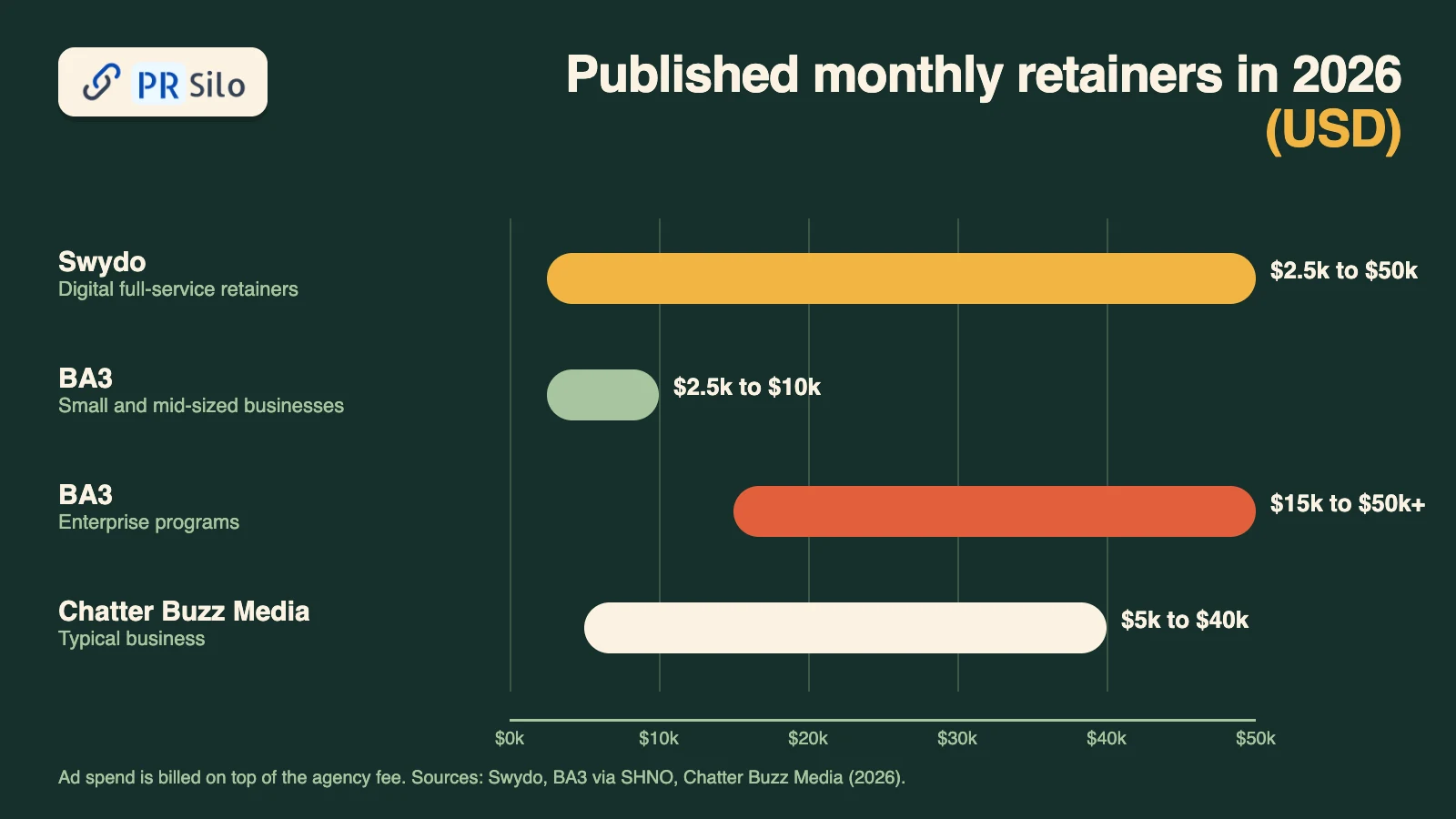
Those ranges look enormous because they measure different things, and the price of full service marketing agency services depends mostly on how many of the eight areas above you actually buy. A $3,000 plan from a three-person shop that runs two channels is not the same product as a $30,000 plan with a strategist, a designer, a developer and an analyst on your account.
What pushes the price up or down
- Scope. Every added channel adds hours.
- Seniority. A named senior strategist on your account costs more than a rotating junior bench.
- Reporting depth. Custom dashboards and attribution work take real effort.
- Contract length. Longer terms sometimes lower the monthly figure.
- Production load. Video and large creative volumes are priced separately by many agencies.
Two invoices, not one
Your ad budget goes to Google, Meta and the other platforms. The agency fee sits on top. One 2026 roundup notes that PPC management fees commonly run between 10 and 20 percent of ad spend. When you compare proposals, check that every quote separates the two, or you will end up comparing a $6,000 fee with a $6,000 fee that secretly includes the ads.
A quick, hypothetical example
Say a regional home-services company pays a $6,000 monthly retainer and sets a $4,000 ad budget. Its real monthly marketing spend is $10,000, not $6,000. If that produces 40 qualified leads and 12 jobs worth $1,500 each, the maths is $18,000 in revenue against $10,000 spent. That is a usable picture. Change the lead quality, the close rate or the job size and the answer flips, which is why reporting has to follow leads all the way to revenue.
Prices that are too good
ClicksGeek makes a point worth repeating: if someone quotes $500 a month for complete PPC management or $750 for full-service SEO, ask how that can possibly be profitable. Skilled marketing labor costs money. A price like that usually means templated work, very little attention or a contract designed to be hard to leave.
When It Is the Right Move (and When It Isn’t)
A full service marketing agency is not a universal fix. It tends to fit if:
- The real problem is coordination, not a missing skill.
- You have enough demand to justify steady work, but not enough volume to staff a department.
- Your in-house marketer is stretched across too many channels.
- You are managing three or more vendors and spending your Mondays chasing updates.
It tends to be the wrong tool if:
- You need one narrow thing done well, such as a technical SEO audit, a site migration or a single video. A specialist is cheaper and usually better.
- You already have strong channel owners in-house who just need a little extra capacity.
- You have not yet found product-market fit. An agency can amplify a working offer, but it cannot invent one.
Plenty of smaller firms land in the first group. A full service marketing agency for small business owners is often the more affordable route to a whole team, provided the scope is trimmed to what the business can fund. Starting with strategy, a website that converts and one or two growth channels beats buying a sprawling package you cannot afford to keep running. And if you are weighing a full service marketing agency for small business growth against one part-time hire, add up the fully loaded cost of the hire before you decide.
How to Choose One You Won’t Regret
Every full service marketing agency pitch sounds convincing in the meeting, and lists of the top full service marketing agencies are everywhere, and many of them are sales material. Some directories mix paid placement into their rankings, and the publisher of a “best of” list frequently ranks itself first. Use these lists to build a shortlist of four or five names, then do your own checking. Search for marketing agency full service and you will get pages of near-identical promises, which is exactly why proof matters more than positioning. There is no single best full service marketing agency for everyone. The one that suits a dental group is rarely the one that suits a software startup, and the best full service marketing agency for your budget may be a smaller shop that will actually return your calls.
Confirm that “full service” is real
Any full service marketing agency worth hiring will answer this plainly. Ask which services are delivered by their own staff and which are subcontracted. Ask who you will meet and who will actually do the work. There is nothing wrong with partnering for specialist production, but you should know where the seams are. A simple tell: when you ask who owns strategy, the answer should be a person with a name.
Look for proof that matches your situation
A case study should show a starting point, an action and a result, with real numbers and a business model close to yours. “Increased engagement” is not a result. Ask for two client references, and ask those clients what happened when something went wrong, because something always does.
Decide whether local matters
Searches for a full service marketing agency near me are common, and proximity does help in a few cases: local SEO, in-person production, events, and businesses whose customers value meeting a human. For most online-first brands, a strong remote team beats a mediocre one down the road. If you are shopping for a full service digital marketing agency near me, treat distance as a tiebreaker rather than a requirement, and check that the agency’s own Google Business Profile reviews read like they were written by real clients. For location-based visibility work, PR Silo’s local SEO services page explains what that involves.
Ask about AI search and measurement
Any agency that sells search work in 2026 should be able to say how it tracks citations in AI answers, what it reports beyond rankings and how it would prove the work paid for itself. Vague talk about “optimizing for AI” with no named method is a warning. The same goes for anyone pitching you the best full service digital marketing agency title on the strength of awards alone. Awards are nice. A reporting sample is better.
Read the contract with your own eyes
The details that hurt later are ownership details. Make sure the ad accounts, analytics property, domain, social accounts and website files are in your name or will be transferred when you leave. Check the minimum term, the notice period and what happens to content created for you. Many agencies handle this well and some do not, so ask before signing, not after.
Questions worth asking before you sign
- Who owns strategy on my account, and how often do I speak to that person?
- Which parts of this work are done by your own staff?
- What will you do in the first 30 days, and what will I see at the end of them?
- How do you report, and can I see a real sample with client details removed?
- Which accounts and assets will be in my name from day one?
- What is the minimum term, and how do I exit?
- How do you handle a change in priorities halfway through a month?
- What would make you tell me this is not the right fit?
The last question is the one to watch. The best answer is a specific one.
What the First 90 Days Should Look Like
Most guides stop at “choose well.” Buyers ask what does a full service marketing agency do in general, then forget to ask what it does in month one. A good full service marketing agency spends its first two weeks listening, and what happens in that first quarter decides whether the relationship works. Some of that depends on you.
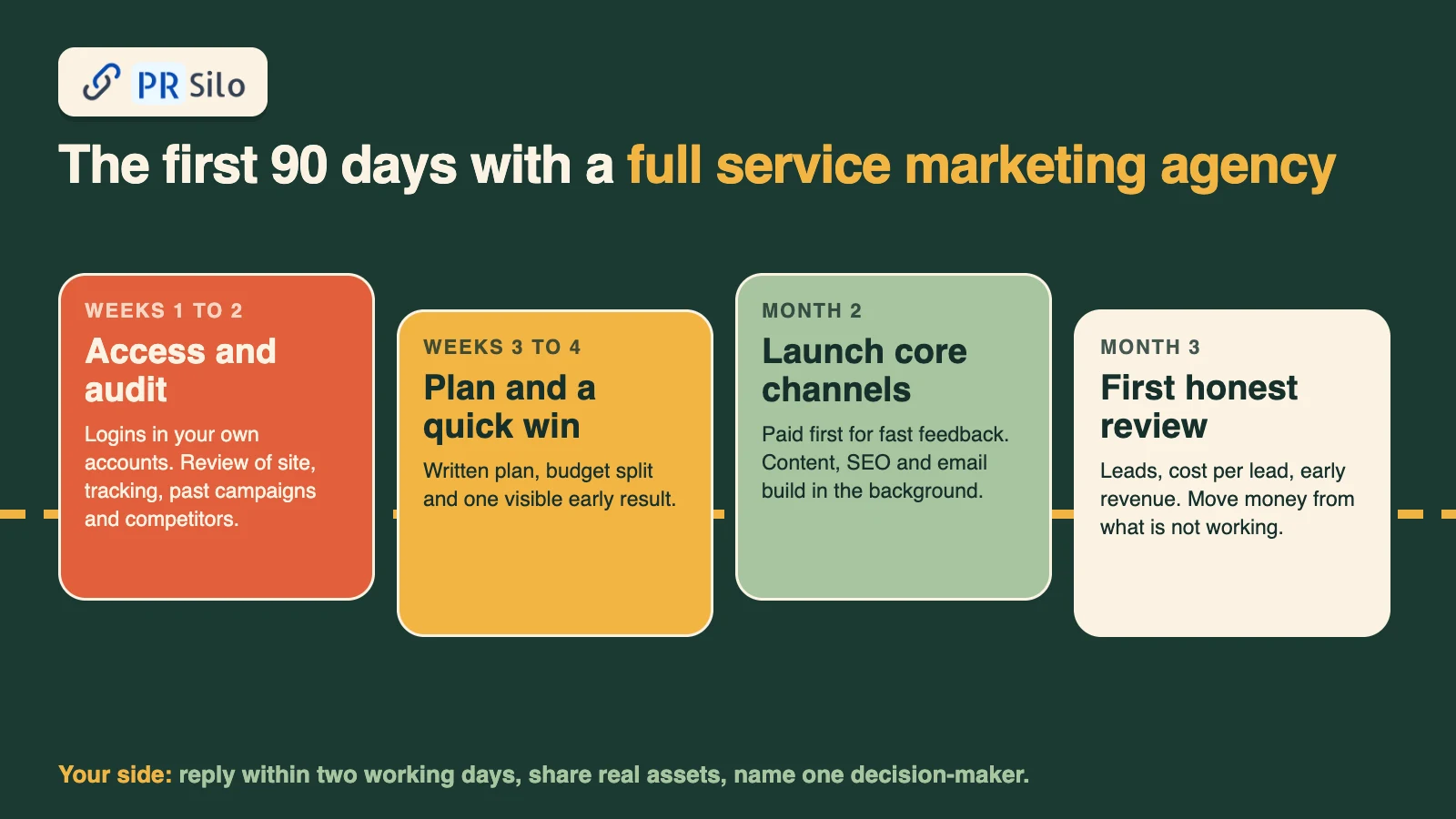
Weeks one and two: access and audit. Hand over logins in your own accounts. The agency reviews your site, tracking, past campaigns, customers and competitors. If it asks for none of this and sends creative ideas instead, that is a flag.
Weeks three and four: plan and a quick win. You should see a written plan with goals, channels and a budget split, plus one visible early result. That could be a fixed tracking setup, a rewritten landing page or a launched email flow. It proves the team can ship.
Month two: launch the core channels. Paid campaigns usually go first because they give feedback fastest. Content, SEO and email work begin building in the background.
Month three: first honest review. Look at leads, cost per lead and early revenue signals. Move money away from what is not working. Expect some things to underperform. That is normal, and it is the point of testing.
Your side of the deal matters too. Reply to feedback requests within two working days, supply real photos and customer stories, and name one decision-maker. Agencies stall when approvals take two weeks and three people disagree.
How to Tell Whether It Is Working
Judge the engagement on business outcomes, not activity. Impressions and follower counts are easy to inflate and rarely connect to revenue.
- Lead quality, not only lead volume. Are the enquiries the kind your sales team wants?
- Cost per acquisition, tracked against what a customer is worth.
- Revenue or pipeline attributed to each channel, with an honest note about what cannot be attributed.
- Search visibility and AI citations, tracked as trends over months.
Timing varies by channel. Paid media gives directional feedback within weeks. SEO, positioning and content programs take months to compound, and any agency promising page-one rankings in thirty days is selling you a story. If you want a sense of how off-site authority builds over that period, PR Silo’s guides on link building and SEO go into it.
Frequently Asked Questions
Q1. What exactly counts as full service?
The short full service marketing agency definition is a company that handles planning, creative, execution and measurement across several marketing channels, so you deal with one team and one plan. The test is ownership: the agency should be able to name who is responsible for strategy, creative and results. If it cannot, you are buying a reseller.
Q2. How is a digital version different from the standard model?
A digital agency sticks to online channels such as SEO, paid media, email and web. A broader integrated shop also handles offline work like events and print. Anyone asking “what is a full service digital marketing agency” as opposed to the broader kind is really asking about channels. Ask any agency calling itself a full service digital marketing agency whether it covers everything you need, or only the parts it likes selling.
Q3. What is the difference between a full-service agency and a specialist?
A specialist goes deep on one channel, such as SEO or paid search. A full-service marketing agency spreads across many channels and connects them under one strategy. If your gap is narrow, a specialist is usually cheaper. If your problem is coordination, the full-service route is cleaner.
Q4. How much does it cost?
Published 2026 ranges vary widely, from about $2,500 a month for a lean small-business plan to $50,000 or more for enterprise programs. Most small and mid-sized businesses fall between $2,500 and $10,000. Ad spend is usually billed on top of the agency fee.
Q5. Is it worth it for a small business?
Often, yes, when you scope it tightly. You get specialists you could not afford to hire one by one, as long as you start with the two or three channels that match your goals. It is a poor fit if your needs are narrow or your offer is still unproven.
Q6. Who is the best full service digital marketing agency?
There is no universal winner. Lists of top full service marketing agencies can help you build a shortlist, but the right pick depends on your industry, budget and the channels that drive your sales. Judge each candidate on proof, named people and contract terms, not on the size of the logo wall.
Q7. Do I have to buy every service?
No. Many agencies let you start with strategy plus one or two channels and add more later. Be cautious of any agency that insists on a bundle without explaining why each piece is in it.
Q8. How long until I see results?
Paid campaigns can show direction within the first month or two. SEO and content programs usually need several months to build momentum. Ask for specific milestones for the first 90 days rather than a promise of fast rankings.
Q9. What do I own if I leave an agency?
It depends on the contract, which is why you should settle it before signing. Aim for ownership of your ad accounts, analytics, domain, social profiles and website files, plus a written handover process.
Q10. How do I find one nearby?
Searching for a full service marketing agency near me is a fine first step, as is trying a full service digital marketing agency near me if you sell online. Then compare agencies on proof, scope and contract terms rather than on distance alone. Read recent client reviews, ask for references and meet the people who would actually run your account.
Your Next Step
Write down your three biggest marketing problems this week and, next to each one, note whether it is a skill gap or a coordination gap. If most are coordination problems, shortlist four agencies and send each the eight questions above. Compare how they answer, not only what they charge.
If search visibility is the missing piece, PR Silo is an SEO and digital PR specialist rather than a full service shop, which means it has no stake in which model you pick. You can look at its SEO services, its guest posting work or get in touch to talk through what your site needs.