
Somewhere around client number twelve, most agencies run out of road. The local work isn’t hard, it’s just endless. Profiles to tidy, listings to chase, reviews to answer, a report due on the 1st. You can’t hire fast enough, and training someone takes the best part of a year. So you start poking around white label local SEO and ask the obvious question: is this smart, or am I about to put my name on somebody else’s mess?
Honestly? Both outcomes are on the table. It comes down to who does the work, what your client sees, and whether you can show proof every month without losing a weekend to spreadsheets. That’s what this guide is for. We’ll go through what the model is, what a decent package holds, which tools are worth paying for, how to price it without fooling yourself, and the Google rules most agencies don’t know they’re breaking.
What White Label Local SEO Actually Means
White label local SEO is local search work that one company does and another company sells as its own. The partner handles Google Business Profiles, listings, reviews and rank tracking. You keep the client, send the invoice and put your branding on every report.
Three players, then. The business owner pays you. You pay the provider a wholesale rate. The provider stays out of sight: no logo on reports, nothing in the client’s inbox, and contact with your client only if you say so.
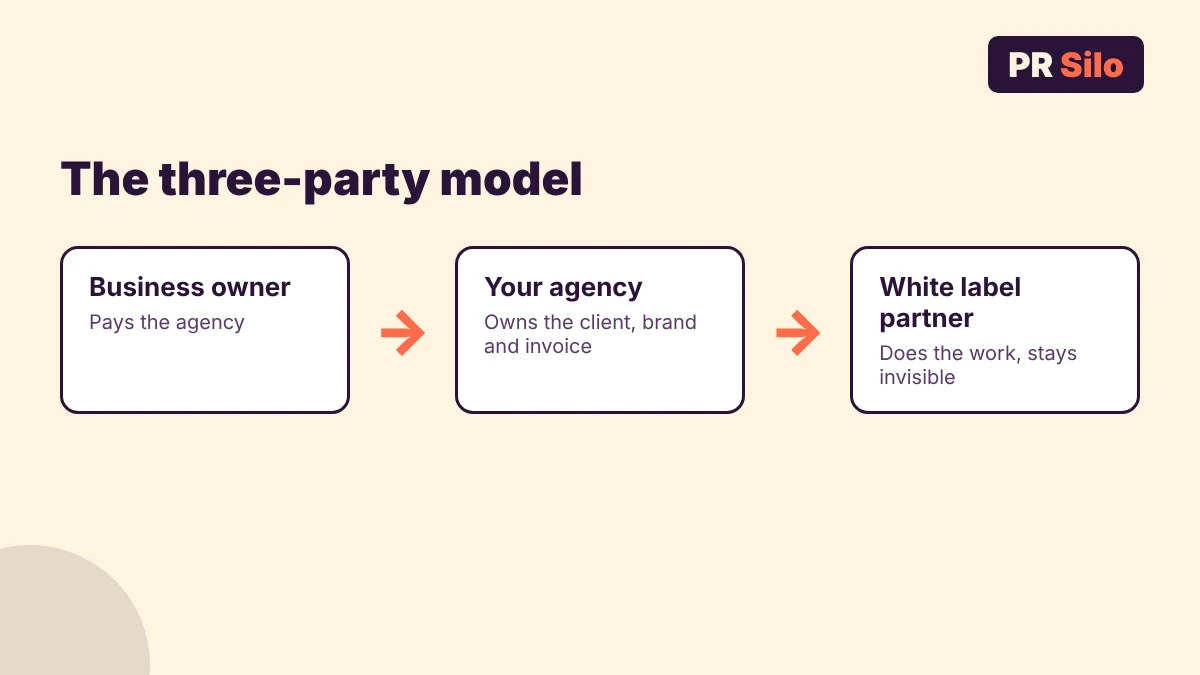
Picture a small web design studio in Leeds. It just built a site for a dental practice, and the owner says, “Can you get us into the map pack too?” The studio has nobody who does local SEO. So it buys a monthly package for $450, adds its own account management, and sells the lot for $1,100. The dentist gets a branded report and a call every few weeks. The partner does the profile work, citations and review replies. Everybody gets paid for something they actually did.
That’s why the model took off. A tiny team can sell a full local service. The catch, and it’s a real one, is that somebody on your side has to know the work well enough to spot a bad month.
How it differs from reselling and referrals
People blur these together, so let’s pull them apart.
A white label SEO reseller buys finished services and sells them on, sometimes with the supplier’s name still visible. A referral is simpler: you hand over the lead, they sell direct, you take a fee. A white label SEO agency (the supplier end of a white label SEO reseller deal, if you like) sits behind your brand and never contacts your client as itself.
What it boils down to is control. Referrals cost you the relationship. White label keeps it, but you also keep the blame when the work is weak.
What a Good Package Includes
Provider menus run long. Real local SEO is about six jobs. If a partner skips one, ask why.
- Google Business Profile work. Categories, services, attributes, descriptions, photos, posts, Q&A. This is the core of white label GBP SEO, and it’s where most ranking gains start. Ask whether your partner’s white label GBP SEO covers posting and Q&A monitoring every month or only the first setup.
- Citations and listings. Fixing and building listings so name, address and phone match everywhere. Providers call it white label listings management or white label citations. Good ones audit what exists before adding anything, since duplicates hurt more than gaps. A decent white label listings management plan includes duplicate suppression, and a white label citations package that only adds new listings isn’t enough.
- Review management. Request flows, drafted replies, monitoring. Replies should sound like the client, not a template.
- On-page local SEO. Location pages, service pages, title tags, schema, internal links.
- Local link building. Sponsorships, local press, partnerships, relevant directories.
- Reporting. Every job above feeds one monthly report. More on that next.
Providers selling white label local SEO services usually bundle these into tiers, and the best white label local SEO services spell out what each tier leaves out. Others charge per location or per deliverable. Neither is wrong. A bundle only works if every piece fits your client, and a one-location plumber doesn’t need ten location pages.
If you want a hand with the work around a profile campaign, our local SEO services and on-page SEO services cover it.
The Report Is the Product
Clients rarely see the work. They see the report. A good white label SEO report can keep a client for three years. A bad one loses them in three months, even if rankings are up.
What goes in it:
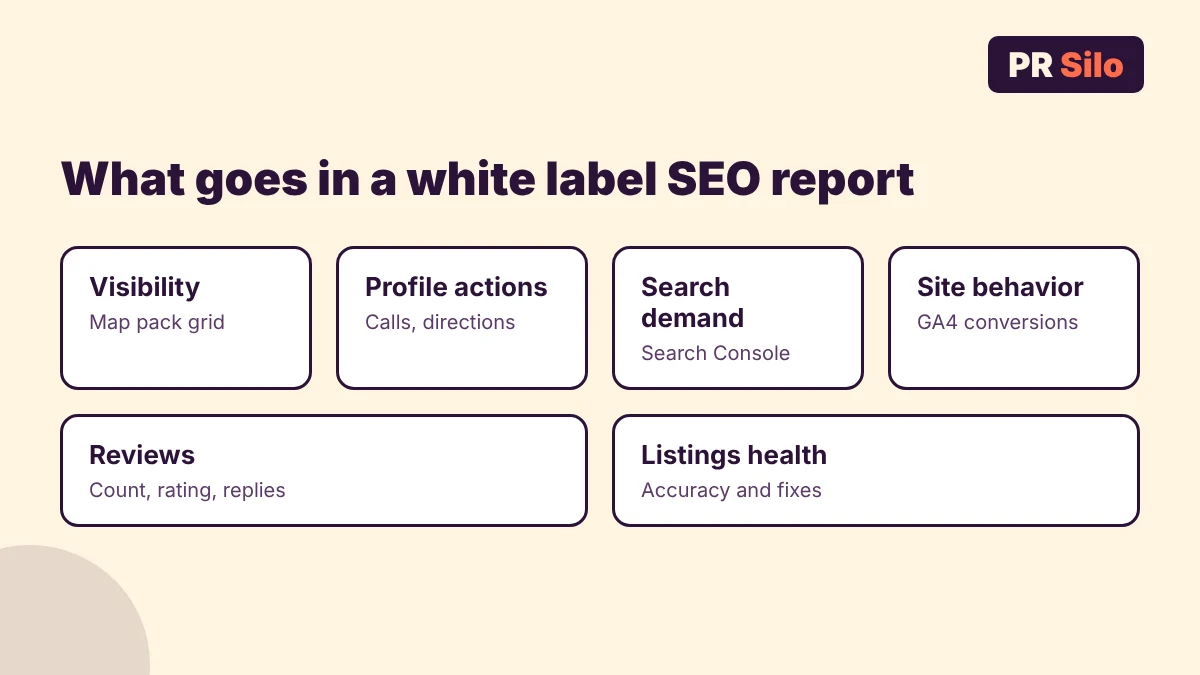
- Visibility. Average map pack position per keyword, shown on a grid so the client sees the whole service area, not just their street.
- Profile actions. Calls, direction requests, website clicks, messages.
- Search demand. Impressions and clicks from Search Console, branded and non-branded split out.
- Site behavior. Sessions, engagement, conversions from GA4.
- Reviews. New reviews, average rating, response rate against last month.
- Listings health. Listing count, accuracy score, fixes done.
- Work completed. A plain list of what happened and what’s next.
- Next steps. One page. Not five.
Keep the whole thing readable in ten minutes. Forty metrics bury the three that matter, so put a summary on page one and shove the rest into an appendix.
Branded reports and dashboards
Branded SEO reports carry your logo, colors and contact details. A live SEO dashboard white label setup goes further: the client logs in and sees current numbers under your name. Both work. PDFs suit people who want an email once a month. Dashboards suit the ones who like to poke around.
A local SEO dashboard is a retention tool too, and branded SEO reports sent from the same system back it up. Clients who log in weekly are watching progress, and that’s easier when the graphs go up and the labels are in plain English.
One warning about domains. Some tools advertise a custom domain, but support varies by feature. BrightLocal’s own FAQ says reports can’t use an agency’s domain, even though its product pages talk up full branding. Check the exact feature on the exact plan before you promise anything to a client.
White Label SEO Reporting Tools Compared
A white label SEO reporting tool saves hours a month, and several good ones exist. Which fits depends on whether you need local tracking, listings, or a general dashboard.
| Tool | Best for | What to know |
|---|---|---|
| BrightLocal | Local rankings, citations and review tracking in one place | 14-day free trial, white label reports on its plans, scheduled weekly or monthly runs, Local Search Grid up to 30 keywords. Reports cannot use your own domain. Pricing changed in 2026, so read its pricing page rather than old reviews. |
| Whitespark | Agencies who want individual tools instead of a bundle | Tools are sold separately. Grid scans cost one credit per grid point, so a 5 by 5 grid uses 25 credits. Shareable live white label links. |
| AgencyAnalytics | One dashboard for local, organic, paid and social | White label dashboards with a custom domain, multiple white label profiles, and email sent from your own address. |
| Moz Local | Listings-focused work | Agencies shortlist it for listings. Confirm its current white label options before building a service on it. |
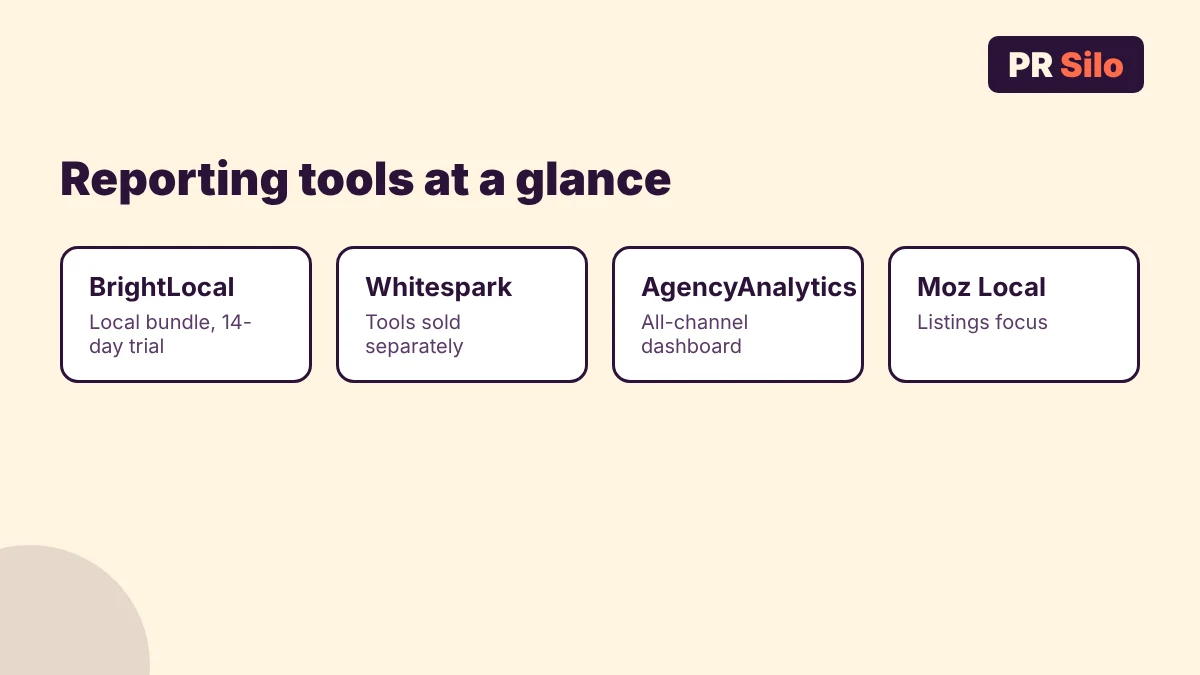
Whichever you choose, judge it as a local SEO reporting tool first. Can it schedule runs? Hide sections you don’t want clients seeing? Export branded SEO reports without cleanup? A good SEO dashboard white label setup should also hand clients a read-only link, and any local ranking report white label view should open on the grid, not a table.
Plenty of agencies end up combining two tools, one for local grids and one for the general dashboard. That adds cost, so only do it if clients will read the extra detail. Most won’t.
BrightLocal in practice
A BrightLocal report is the easiest place to start for local work, since rank tracking, citations and review monitoring all sit under one login. The trial runs 14 days with no card, so you can build a real client report before paying a cent. Pulling a BrightLocal report for a prospect ahead of a sales call is a cheap way to show them where they stand. Its bright local SERP checker shows where a business appears for a search and lets you compare against competitors. Try the bright local SERP checker on a prospect’s three most valuable keywords and bring screenshots to the first meeting.
The downsides: the domain limit above, and a price that has moved. Don’t trust any figure from an old review.
BrightLocal vs Whitespark
The BrightLocal vs Whitespark debate turns up in every agency forum. They solve slightly different problems, so it’s less “better versus worse” and more “bundle versus toolbox”. BrightLocal gives you one subscription and one consistent report. Whitespark lets you buy only the grid scans or citation tools you need.
People who ask whitespark vs bright local usually care about three things: cost at their client count, how the white label output looks, and how easy it is to automate. A whitespark vs bright local roundup on a vendor’s blog is a poor stand-in for testing, so run your own. With fewer than ten local clients, put both on the same business and compare the reports side by side. And if you’re hunting for a BrightLocal alternative because of the 2026 price change or the domain limit, Whitespark and AgencyAnalytics are where most agencies end up, so pick one as your BrightLocal alternative and trial it on a live account.
One more name that comes up: white label Moz Local. Moz Local is built for listings, and some agencies pair it with a grid tool. If listings are a small slice of what you sell, you may not need white label Moz Local at all.
White Label Rank Tracker and Grid Scans
A white label rank tracker that shows one position per keyword will mislead your client. A business can rank first at its own front door and fourteenth two miles away. Grid scans fix that by checking rankings from lots of points around the business.
Size matters. Start around 2 miles for dense city areas, 5 for suburbs and 10 for rural markets, then adjust to where the client really finds customers. Bigger grids burn more credits and often show more red squares, which can spook someone who’s never seen one. Explain the colors before the first report, not after.
A local ranking report white label version should show the grid, the average position and the change since last month, plus a sentence on what moved and why.
White Label SEO Audit and Free Report Options
A white label SEO audit is the easiest sales tool you own. Scan a prospect’s site and profile, send the result under your brand, book a call. Most reporting platforms include an audit tool, and some partners will build one for you.
What about a free white label SEO report? They exist, and a free white label SEO report is handy for lead generation, but the limits bite. Usually a few pages or one keyword, light branding, no live dashboard. Use them for prospecting. Once you have clients, pay for a proper plan, because a white label SEO report generator that runs on a schedule is what keeps monthly work consistent. Choose a white label SEO report generator that fills your template on its own.
For a closer look at what an audit should flag, see our technical SEO services page, which lists the checks we run before any local campaign.
White Label Webmaster Tools Reports
Search Console and GA4 are free, and they’re as close to ground truth as a local campaign gets. A white label webmaster tools report pulls their data into your branded template so the client never sees a Google login.
Show clicks and impressions from Search Console, split between searches that include the business name and those that don’t. Branded growth is nice. Non-branded growth shows the campaign is reaching new people. In GA4, report conversions that count: calls, form fills, booking clicks. Not just sessions.
Looker Studio is a free route if you want to build this yourself. An afternoon to set up, a few minutes a month after that. Paid tools do the same job in fewer steps.
Staying on the Right Side of Google
This is the part nearly every competitor guide skips.
Google’s third-party policy for Business Profile says that if you charge a management fee, you have to tell the business in writing, before you manage the profile, that Business Profile is free. The fee must also appear on invoices. The business should own or co-own its profile, and you should never ask for or share their Google password. Access goes through the manager invitation system.
For a white label setup, your client agreement needs a short paragraph covering all that, and your provider should be added as a manager by invitation, never through a shared login. Ask any partner how they handle access before you sign. The policy is on Google’s Business Profile help pages.
Also steer clear of anyone selling click manipulation or fake engagement. CTR boosters break Google’s rules, and the penalty lands on your client’s listing, not the provider.
How to Choose a White Label Local SEO Partner
Picking a white label local SEO partner is a hiring decision, not a shopping trip. Your name goes on their work. Run these checks.
- Ask for a sample report and task log. No real examples with names removed? Walk away.
- Ask who does the work. Staff, contractors, another reseller? A third layer usually means slower replies and weaker quality.
- Check communication terms. Will they talk to your client, under your brand, if you ask? Stay invisible if you ask for that?
- Read the contract for non-solicit terms. You don’t want your provider approaching your clients.
- Lock the rate. How long is wholesale pricing fixed? A rate change on 30 days’ notice can wreck a margin.
- Test with one client. Start small, read the first two reports yourself, then add accounts.
- Confirm Google compliance. How do they get profile access, and what do they do about disclosure?
Pricing pages from different white label SEO providers rarely line up, so compare scope before you compare cost. Warning signs: guaranteed rankings, secret methods, no reporting, prices far below market. A white label SEO provider that can’t explain its work in plain words is hiding something or doesn’t know.
When you compare white label SEO providers, ask each the same ten questions in the same order and score the answers. It makes a muddy decision clearer.
White Label SEO Pricing and Margins
Pricing is where agencies quietly lose money. Wholesale cost is only part of what a client costs you.
Use this: selling price = loaded cost divided by (1 minus your target margin).
Loaded cost is the partner’s fee plus your tools, your account management time and a slice of overhead. For example:
- Partner fee: $400 a month
- Reporting tool share: $30
- Account management, two hours at $50: $100
- Overhead share: $20
- Loaded cost: $550
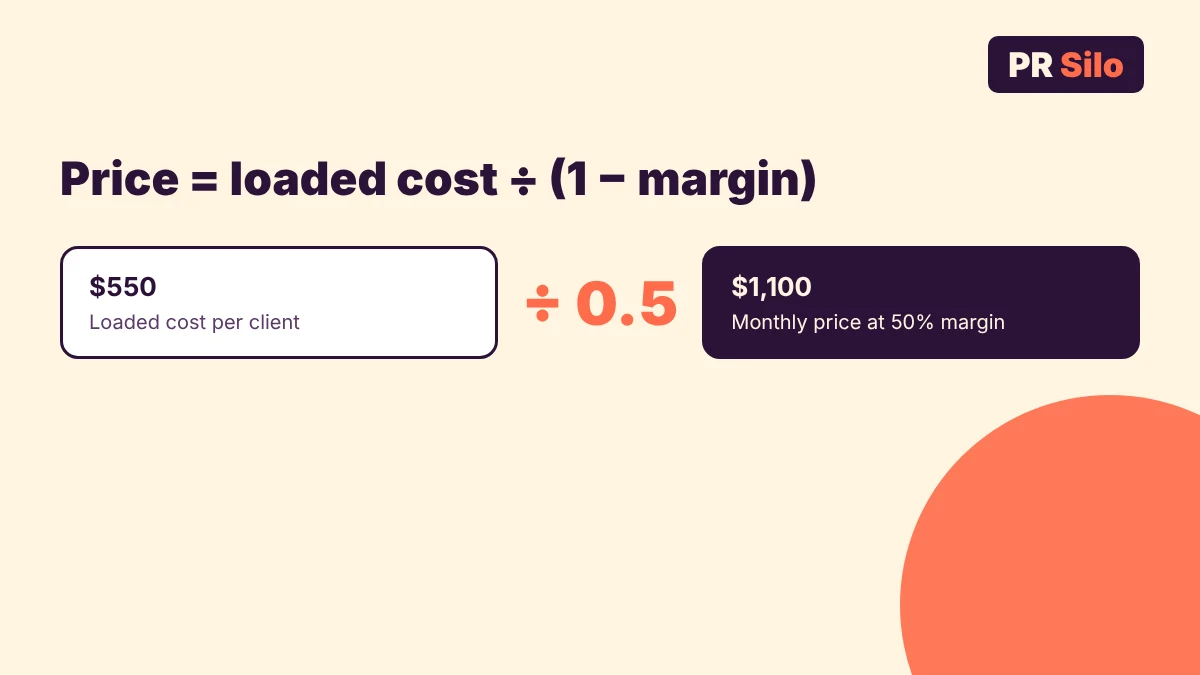
At a 50 percent margin, the price is $550 divided by 0.5, so $1,100. At 60 percent it’s $1,375. You’ll see agencies quote 45 to 65 percent margins on resold work, but that only holds if management time is counted honestly.
On white label SEO pricing, providers run from under $100 for basic audits to $800 or more a month for fuller packages, and white label local SEO pricing follows the same wide spread, so ask every provider for white label local SEO pricing by location count. Retail prices in agency guides run from roughly $800 to $6,000 a month depending on locations and competition. Treat those as orientation and get quotes for your own market.
Work out break-even too. Say the service costs you $2,000 a month in tools and a part-time account manager, and each client nets $450 after wholesale. You need about five clients just to cover the fixed costs. One client doesn’t make it pay.
What About AI Search Visibility?
Clients now ask whether their business shows up in AI answers, not only the map pack. It’s new enough that few reporting tools handle it well.
You can still add a simple section. Run a fixed set of local prompts each month, like “best emergency plumber in [city]”, note which businesses get named, and record whether your client does. It’s manual, but it gives clients a straight answer and shows you’re watching where search is heading. Our off-page SEO services and digital PR services cover this side, since mentions and links from trusted sources feed both classic and AI results.
When White Label Is the Wrong Choice
Skip it if you only have a few local clients and plenty of spare time. Skip it if you can’t judge the work, because you won’t catch problems. Skip it if your clients expect to talk to the person doing the work every week. And skip it if you’re trying to patch a weak service instead of growing a strong one.
FAQ
What is white label local SEO?
It’s local SEO done by one company and sold by another under its own brand. The provider handles profile work, listings, reviews and reports. The agency handles the client and the invoices.
How much does white label local SEO cost?
Wholesale packages commonly run from a few hundred dollars a month for one location, more for multiple locations or competitive markets. Set your retail price from loaded cost and target margin, using the formula above.
Does the client know a partner is involved?
Only if you tell them. Many agencies stay invisible, but be honest about who has access to the Business Profile and follow Google’s disclosure rules for fees.
What is the difference between white label and reseller?
A reseller buys services and sells them on, sometimes with the provider’s name showing. White label means the provider’s name never appears. In daily use the terms overlap, so read each contract’s wording.
How do I choose a provider?
Ask for sample reports, find out who does the work, read the contract for non-solicit and rate terms, test with one client and confirm how they handle Google access.
Who owns the Google Business Profile?
The business should own it or co-own it. Agencies and providers get added as managers and should never hold the only owner login.
How long until results show?
Profile and listing fixes can move rankings in weeks. Competitive markets often take three to six months. Report progress from month one with leading metrics like profile actions and grid coverage.
How many clients do I need to make it worthwhile?
It depends on fixed costs. Using the break-even example above, if the service costs $2,000 a month to run and each client nets $450, five clients cover it.
Can I use a free tool instead of paying?
For prospecting, yes. For ongoing client work, a paid plan with scheduled white label SEO reports saves enough time to pay for itself within a couple of accounts.
The Short Version
This model works when the report is the product, the partner is a hire, and Google’s rules are treated as real. Pick a reporting tool you’re proud to show clients, price from loaded cost, document Google access, and test on one account first. If you want help on the link and authority side, our guest posting and link insertions services pair well with any local campaign, and there are more guides on the PR Silo blog.